Insights
How iGaming link building works: a 2026 guide
iGaming link building is the deliberate acquisition of editorially relevant backlinks in a YMYL niche where low-quality links carry outsized risk. Topical relevance beats domain authority, compliance sits inside the process rather than after it, and — across eight weekly measurements of our own domain — the vendor metrics most teams report against move independently of search performance.

iGaming link building is the deliberate process of acquiring authoritative backlinks from relevant, trusted sources in the gambling industry to boost search visibility and domain trust. Unlike general SEO, this practice sits at the intersection of strict regulatory compliance, Google’s YMYL (Your Money or Your Life) content standards, and a niche where low-quality links carry outsized penalties. Tools like Ahrefs and SEMrush are standard for competitor backlink analysis, while platforms such as the UK Gambling Commission (UKGC) and the Malta Gaming Authority (MGA) set the compliance boundaries that shape every link placement decision. Understanding how igaming link building works means understanding that authority here is earned through editorial relevance, not volume.
How does iGaming link building actually work, step by step?
Every effective iGaming link building campaign starts with a clear ranking goal tied to a specific target page. Without that anchor, you are acquiring links for the sake of metrics rather than rankings.
The first operational step is competitor backlink analysis. Practitioners map the link profiles of the top 5–10 competing sites before placing a single link. This reveals referring domain patterns, anchor text distribution, and link velocity, which together show you the authority gap you need to close and the pace at which you need to close it.

From that analysis, you build a source shortlist. The criteria are strict: contextual relevance to gambling or sports betting, real organic search traffic to the linking page, and editorial standards that satisfy Google’s YMYL threshold. A link from a high-DA lifestyle blog with no gambling content is worth far less than a link from a mid-authority casino review site with 10,000 monthly organic visitors.
Anchor text control is the next critical variable. Safe anchor strategy favours branded and neutral anchors, with exact-match anchors used sparingly and only on pages with strong contextual trust. Over-optimised anchor profiles are one of the fastest routes to an algorithmic penalty in this niche.
- Define target pages and ranking objectives before outreach begins.
- Analyse the backlink profiles of 5–10 direct competitors using Ahrefs or SEMrush.
- Build a source shortlist based on topical relevance and organic traffic, not domain authority alone.
- Plan anchor text distribution: mostly branded and neutral, minimal exact-match.
- Acquire links at a gradual, consistent pace that mirrors organic growth patterns.
Pro Tip: Set a monthly link acquisition budget by page, not by site. This forces you to prioritise your highest-value commercial pages and prevents you from spreading authority too thin across a large site.
How do compliance and regulatory requirements shape iGaming link building?
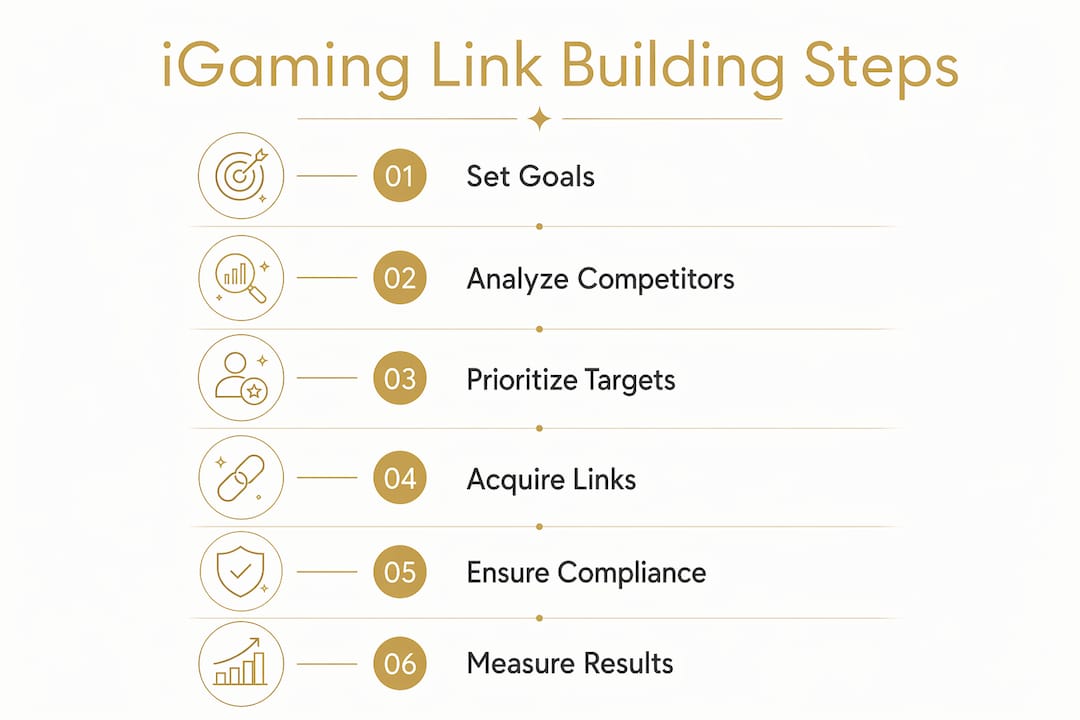
Compliance is not a box you tick after building a link. Regulatory compliance must be integrated with SEO as part of the content review and link placement process from the start. Treating them as separate workstreams is how iGaming sites earn manual penalties.
The regulatory environment varies significantly by jurisdiction. The UKGC prohibits inducement language and requires responsible gambling messaging on any content targeting UK players. The MGA has its own standards for Malta-licensed operators. US states like New Jersey and Michigan each carry additional advertising and content restrictions. A link placed on a page that violates any of these standards can trigger a manual review, even if the backlink itself is technically high quality.
The risks are specific and serious:
- Inducement claims: Phrases like “guaranteed winnings” or “risk-free bets” in linking content can constitute a regulatory breach.
- Missing risk warnings: Content that promotes gambling without responsible gambling disclosures may violate UKGC and MGA guidelines.
- Non-compliant bonus language: Describing bonuses without terms and conditions references is a common compliance failure in affiliate linking content.
- Jurisdictional mismatch: Linking from content that targets a jurisdiction where your operator is not licensed creates both legal and SEO exposure.
Ignoring the compliance of the linking page can cause Google to trigger manual or algorithmic penalties even when the backlink itself is relevant and well-placed. Google’s quality raters assess the full content context, not just the link.
Pro Tip: Before finalising any link placement, run the hosting page through a compliance checklist aligned to the target jurisdiction. A 10-minute review can prevent a months-long penalty recovery.
What types of links generate the most sustainable authority in iGaming?
Not all backlinks carry equal weight in the gambling niche. Google treats gambling content as YMYL, applying a higher trust threshold that makes topical relevance the dominant quality signal. A backlink from a contextually aligned gambling site with real traffic outperforms a generic high-DA link every time.
Here is how the most common link types compare:
| Link type | Strength | Best use case |
|---|---|---|
| Editorial backlinks from gambling media | Very high | Operators building brand authority |
| Guest posts on niche gambling sites | High | Affiliates targeting commercial keywords |
| Niche edits in existing gambling content | High | Both operators and affiliates |
| Data-driven PR placements in news outlets | Very high | Operators with original research |
| Footer or sidebar links | Low | Avoid for primary SEO campaigns |
Links placed naturally within main body content pass stronger SEO signals than footer or sidebar placements. Placement depth matters as much as the domain itself.
Original research is the highest-leverage content format for earning editorial links. One comprehensive player behaviour study earned 47 backlinks from news outlets without any active outreach. Proprietary data gives journalists and editors a reason to cite you rather than a competitor.
The YMYL designation for gambling also means that purely promotional content is increasingly rejected by quality publishers. Educational, journalistic, and responsible gambling content earns editorial acceptance. Promotional content gets declined or, worse, placed on low-quality sites that damage your profile.
For iGaming affiliates specifically, understanding how your content strategy integrates with link building is what separates a sustainable SEO programme from one that collapses after the next Google update.
How should iGaming affiliates and operators approach link building differently?
Operators and affiliates operate in the same niche but require fundamentally different link building approaches. Using operator strategies on affiliate sites often triggers algorithmic penalties because the content intent and compliance requirements differ significantly.
Operators build authority through scale and brand recognition. Their link building leans toward digital PR, data publishing, and earning placements in mainstream sports and finance media. A licensed casino operator publishing an annual gambling behaviour report can earn dozens of editorial links from outlets like The Guardian or BBC Sport. That strategy does not translate to an affiliate site reviewing slot games.
Affiliates, by contrast, need links that reinforce commercial review content. Their focus is on gambling-specific publishers, comparison sites, and niche editorial outlets that cover casino and betting topics. Topical relevance is the dominant ranking factor for gambling backlinks, and for affiliates, that means building relationships with a narrow pool of specialised publishers rather than chasing broad media coverage.
Key distinctions between the two approaches:
- Operators prioritise brand-level authority signals, PR-driven placements, and mainstream media coverage.
- Affiliates prioritise niche editorial links, review content endorsements, and gambling-specific referring domains.
- Both must avoid bulk transactional link buying, which carries a high risk of penalties under Google’s current algorithms.
- Affiliates face greater exposure under Google’s review update cycles, which specifically target thin commercial content.
Long-term, relationship-driven link building focusing on a narrow pool of specialised gambling publishers consistently outperforms transactional link buying. The short-term volume gains from bulk purchases rarely survive a core update. Building genuine editorial relationships with five to ten relevant publishers is worth more than 50 directory-style placements.
Affiliate brand safety considerations also shape link building decisions. Unnatural link spikes, even from legitimate sources, can flag a site for review if they do not align with the site’s content output and traffic growth.
What are the best practices for measuring and sustaining an iGaming link campaign?
Measurement is where most iGaming link building programmes fall apart. Practitioners track the wrong metrics, miss early warning signs, and only notice problems after rankings have already dropped.
- Track page-level rankings, not just domain metrics. A rising domain rating means nothing if the target commercial pages are not moving up in search results. Tie every link acquisition to a specific page and keyword cluster.
- Monitor anchor text distribution monthly. Use Ahrefs or SEMrush to review your anchor profile. If exact-match anchors are creeping above 5–10% of your total profile, slow acquisition and shift to branded and neutral anchors immediately.
- Check the organic traffic of linking pages after placement. The critical quality measure for gambling backlinks is actual organic search traffic to the linking page, not domain authority. A page that loses its traffic after you earn a link from it is no longer passing meaningful authority.
- Maintain consistent link velocity. Sustained, gradual link acquisition that mimics organic growth reduces penalty risk. Tie acquisition pace to real content output and marketing activity, not arbitrary monthly targets.
- Audit your backlink profile quarterly. Remove or disavow links from pages that have become non-compliant, lost traffic, or shifted to unrelated topics. A clean profile is easier to defend than a large one.
Editorial standards on your own site also affect how well your link building converts into rankings. Publishers are more willing to link to sites with clear editorial policies and transparent authorship, both of which Google’s quality raters reward.
What do link metrics actually predict? Eight weekly measurements
Everything above is the received practice, and most of it is sound. What it does not tell you is whether the metrics used to report on a link programme track anything real. Between 17 July and 4 September 2026 we instrumented this site’s own profile weekly — Ahrefs domain rating, total and followed referring domains, and Search Console clicks, impressions, average position and indexed URL share — and the two sets of numbers moved independently.
The measurement was involuntary, which is what makes it useful. This domain has been absorbing an unsolicited private blog network blast since May 2026, arriving in waves that have run as high as 150 domains a month with no outreach, no budget and no editorial relationships behind it. Publishing and outreach stayed flat throughout. Link volume was therefore the only variable moving, which is a cleaner experiment than any deliberate campaign would give you.
| Week ending | Ahrefs DR | Referring domains | Followed ref. domains | Clicks (28d) | Impressions (28d) | Avg position |
|---|---|---|---|---|---|---|
| 2026-07-24 | 14 | 325 | 29 | 1 | 344 | 35.4 |
| 2026-07-31 | 14 | 368 | 25 | 1 | 355 | 34.9 |
| 2026-08-21 | 13 | 454 | 34 | 3 | 160 | 13.6 |
| 2026-08-28 | 13 | 392 | 48 | 3 | 148 | 16.2 |
| 2026-09-04 | 14 | 350 | 58 | 5 | 133 | 19.4 |
The series runs to eight weekly observations; the three omitted from the table are 17 July, when the backlink fields were not recorded, and 7 and 14 August, when the vendor session was signed out and the link metrics were recorded as missing rather than estimated. Search Console figures were collected in all eight weeks.
Three findings came out of it.
Followed referring domains more than doubled while domain rating finished where it started. The followed count went from 25 on 31 July to 58 on 4 September, a 132% rise over five weeks. DR across the same period went 14, then 13, then back to 14. Ahrefs states that DR is influenced by the number of referring domains, the DR of those domains, and how many sites each of them links out to, with nofollow links excluded. A cohort of DR-0 donors that each link out to thousands of sites satisfies the first input and cancels itself out on the other two. Nothing in the disclosed formula reads the linking page’s traffic or its spam classification, which is precisely the information a link buyer needs.
The vendor’s own spam flag accounts for the entire gain. On the 4 September check, all ten of the largest followed referring domains carried the Ahrefs spam flag. The followed count on this profile is not a measure of links earned; it is a measure of spam accumulated. A team reporting “followed referring domains: 58, up from 25” as a monthly link-building KPI would be claiming a 132% improvement in a month when nobody built a link.
The headline referring-domain count is not even monotonic. It ran 325, 368, 454, 392, 350 across the window while no links were removed — crawl-index churn on the vendor’s side rather than link loss. Two of those weeks would have read as a decline in any report that took the header figure at face value. Enumerating the report rows instead of trusting the header is the only way to get a stable number: on one audit the header claimed 464 referring domains while enumeration returned 415 unique hosts.
Search performance over the same window moved on an unrelated axis. Impressions fell while average position improved from 35.4 to 19.4 and the final 28-day window recorded 5 clicks against 133 impressions — fewer, better-matched impressions, driven by which pages Google chose to index (36 of 79 URLs at the end of the window) rather than by anything in the link profile. AI answer engines were less discriminating still: the same domain logged 156 citations in a 30-day window at DR 13, so citation volume is not gated on the authority metric either.
What we changed as a result. Followed referring domains came off the reporting sheet as a growth metric. Three measures replaced it:
- Referring domains that are not spam-flagged, enumerated from report rows rather than the summary header. On this profile that is a single-digit number, and it is the only one that moves when real work happens — two app directories started linking in late August after our iOS apps shipped, the first genuinely earned links the domain has picked up.
- Indexed URL share in Search Console. Thirty-six of 79 URLs at the end of the window. A link that does not change what gets indexed has not changed anything you can monetise.
- Query composition rather than click count. Five clicks means little; five clicks all sitting on the brand name means the non-branded programme has not started working yet, which is a different and more actionable statement.
The disavow question follows from this rather than driving it. Google scopes the disavow tool to sites with a manual action for unnatural links or an expectation of one, and the tool does not support Domain properties in Search Console. There is no manual action on this domain. We maintain the file anyway — 499 domains as of 7 September 2026 — as cheap precautionary hygiene on a young site with little legitimate authority to lose, while accepting it may be doing nothing at all. That is the honest version of most disavow decisions.
Key takeaways
Effective iGaming link building requires topical relevance, compliance integration, and gradual acquisition pacing to build sustainable authority in the gambling niche.
| Point | Details |
|---|---|
| Start with competitor analysis | Map the backlink profiles of 5–10 competitors before placing any links. |
| Prioritise topical relevance over DA | Links from niche gambling sites with real traffic outperform generic high-DA placements. |
| Integrate compliance from the start | Non-compliant linking content triggers penalties regardless of backlink quality. |
| Separate operator and affiliate tactics | Applying operator-style PR campaigns to affiliate sites causes algorithmic suppression. |
| Measure page-level rankings, not domain metrics | Track ranking movement on target pages and monitor anchor text distribution monthly. |
| Segment link counts by spam flag before reporting | Ours rose 132% in five weeks with zero links built; all ten top followed referrers were spam-flagged. |
Why I think most iGaming link building fails before it starts
After two decades in iGaming media, the pattern I see most often is this: a team invests in link building before they have sorted out their content and compliance foundations. They chase domain authority scores, buy placements in bulk, and then wonder why a core update wipes out six months of gains.
The uncomfortable truth is that in a YMYL niche, Google is not just evaluating your backlinks. It is evaluating the entire editorial ecosystem around your site. A link from a reputable gambling publisher lands differently when it points to a page with clear authorship, responsible gambling messaging, and original analysis versus a thin commercial page stuffed with affiliate links.
I have also seen operators apply mass PR strategies to affiliate properties and affiliates try to replicate operator-level brand campaigns. Both approaches fail for the same reason: the content intent does not match the link strategy. Operators earn trust through scale and brand recognition. Affiliates earn trust through depth, specificity, and niche authority.
My strongest advice is to build relationships with five to ten publishers who genuinely cover your niche, produce original data at least twice a year, and treat compliance review as a pre-publication step rather than an afterthought. That approach is slower. It is also the only one that survives.
— Lucky
How does Lucky Universe approach link building on its own properties?
Lucky Universe runs a portfolio of iGaming media and app properties and publishes the measurement from them rather than case-study claims. The programme described above is the working method: no purchased placements, a disavow file maintained against an ongoing spam blast, and a reporting sheet built on non-spam referring domains, indexed URL share and query composition instead of aggregate link counts. Where that produces a result worth reporting — including null results like this one — it gets published here.
Recommended
Frequently asked
Quick answers.
- What is iGaming link building?
- iGaming link building is the strategic acquisition of backlinks from relevant, authoritative gambling and sports betting sources to improve a site's search rankings and domain trust. It differs from general link building because it must satisfy both Google's YMYL standards and jurisdiction-specific gambling regulations.
- Why does topical relevance matter more than domain authority in iGaming?
- Google prioritises contextually aligned sources in sensitive niches like gambling, so a link from a niche casino review site with real organic traffic outperforms a generic high-DA link. Domain authority scores can be inflated or misleading, while actual organic traffic to the linking page is the more reliable quality signal.
- How do affiliates and operators differ in their link building approach?
- Operators focus on large-scale digital PR and data-driven publishing to build brand-level authority, while affiliates concentrate on niche editorial links and gambling-specific referring domains. Applying operator-style mass PR campaigns to affiliate sites typically triggers algorithmic penalties due to mismatched content intent.
- What anchor text strategy is safest for iGaming SEO?
- Branded and neutral anchors should make up the majority of your anchor profile, with exact-match anchors used sparingly and only on highly trusted contextual pages. Over-optimised anchor distributions are a leading cause of algorithmic penalties in the gambling niche.
- How often should I audit my iGaming backlink profile?
- A quarterly audit is the minimum standard for active iGaming link building campaigns. Use tools like Ahrefs or SEMrush to identify non-compliant linking pages, lost-traffic placements, and anchor text drift before they compound into a larger SEO problem.
- Is a rising followed referring domain count evidence that link building is working?
- Not on its own. On our own domain the followed count rose from 25 to 58 between 31 July and 4 September 2026 — a 132% increase — during a period in which no links were built and no outreach ran. Every one of the ten largest followed referrers at the end of that window was flagged as spam by Ahrefs. Segment the count by spam flag before reporting it, or the metric rewards you for being attacked.
- Should you disavow unsolicited spam backlinks?
- Google scopes the disavow tool to sites that have a manual action for unnatural links or expect one, and it does not support Domain properties in Search Console. We have no manual action and disavow anyway, as precautionary hygiene on a young domain with little legitimate authority, while accepting the file may be doing nothing.
Sources
- Domain Rating (DR) — Ahrefs SEO glossary — ahrefs.com
- Disavow links to your site — Google Search Console Help — support.google.com
- Spam policies for Google web search — Google Search Central — developers.google.com
- December 2022 link spam update releasing for Google Search — Google Search Central Blog — developers.google.com