Insights
How iGaming influencer marketing works in 2026

If you think influencer marketing in iGaming is simply about putting your logo in front of a streamer’s audience, you are leaving serious money on the table. Understanding how iGaming influencer marketing works means recognising it as a compliance-governed, multi-layer conversion funnel that demands the same rigour as any performance marketing channel. Done right, it drives measurable player acquisition with trackable lifetime value. Done wrong, it creates regulatory exposure that can cost operators far more than the campaign itself. This guide covers the full picture: platforms, compliance obligations, attribution models, and execution tactics that actually produce ROI.
Table of Contents
- Key takeaways
- How iGaming influencer marketing works: the foundations
- Compliance and regulation in influencer marketing
- Tracking and measuring campaign success
- Campaign execution and optimisation
- Regulatory risks and emerging trends
- My perspective on compliance-led influencer marketing
- Take your influencer campaigns further with Myluckyuniverse
- FAQ
Key takeaways
| Point | Details |
|---|---|
| It is a conversion funnel | Influencer campaigns track clicks, registrations, and first-time deposits, then measure player lifetime value. |
| Compliance is non-negotiable | Operators bear legal responsibility for influencer content, making pre-approval and monitoring mandatory. |
| Multi-layer attribution is required | Combining UTM tagging with promo codes and affiliate dashboards gives accurate, gap-free conversion tracking. |
| Long-term partnerships outperform one-offs | Converting top influencers into brand ambassadors consistently improves campaign ROI over time. |
| Regulatory risk is growing | Enforcement attention on unlicensed gambling promotions is increasing, making compliance workflows a strategic asset. |
How iGaming influencer marketing works: the foundations
Most marketing channels have a relatively simple structure. Influencer marketing in gaming does not. The ecosystem spans Twitch streamers hosting live casino sessions, YouTube analysts breaking down sportsbook odds, Instagram poker personalities reviewing card rooms, and TikTok creators producing short-form slot content. Each format serves a different audience and a different campaign objective, which means your strategy needs to start with matching the influencer type to the goal you are trying to achieve.
Typical campaign objectives fall into three broad categories. Brand awareness campaigns prioritise reach and engagement, usually measured by impressions and view counts. Player acquisition campaigns focus entirely on registrations and first-time deposits, making conversion tracking the centrepiece. Product showcase campaigns sit in between, using detailed reviews or live play sessions to demonstrate a platform’s features to an already-interested audience.
The platform choice matters enormously here. Live streams on Twitch work well for real-time community building and building trust through unscripted play. YouTube suits longer-form reviews and tutorials where users are actively researching before signing up. Short-form video on TikTok and Instagram Reels reaches younger audiences quickly but carries tighter regulatory scrutiny. Understanding platform-specific dynamics is one of the fundamentals that separates a mediocre campaign from a high-performing one.
What makes iGaming influencer marketing distinct from consumer goods or software is the role of community trust. A slot streamer with 80,000 highly engaged followers in a specific regional market will consistently outperform a broad-reach celebrity with millions of followers who has no gambling content history. Niche authority, not raw audience size, drives conversions in this space.
Pro Tip: When vetting influencers, ask for audience demographic data, not just follower counts. Age distribution, geography, and prior engagement with gambling content are far stronger predictors of campaign performance than reach alone.
Compliance and regulation in influencer marketing
This is the section most agencies skip, and it is the section that gets operators into trouble. Under the EGBA’s 2025 Pledge, participating operators commit to transparency, mandatory audience demographic checks, and independent monitoring across all influencer campaigns. Age-gating and location controls are not optional add-ons. They are structural requirements.
The critical legal reality that many iGaming marketers underestimate is this: operators bear legal responsibility for the marketing content influencers publish on their behalf, regardless of how the contract is structured. If an influencer posts non-compliant content, the regulatory consequence lands on the operator. That reality fundamentally changes how you need to manage these relationships.
“The market evolves from creator play content into monetized influence with regulatory oversight required.” — IMGL Magazine on regulating influencer marketing in gaming and gambling
A properly structured compliance workflow has four stages. First, the brief: all influencers receive detailed written guidance covering mandatory disclaimers, responsible gambling messaging, prohibited claims, and geo-restriction requirements before any content is created. Second, pre-approval: content is reviewed by your compliance or legal team before it goes live. Third, active monitoring: published content is checked regularly for edits or additions that may introduce non-compliant elements. Fourth, contractual coverage: agreements must specify pre-approval and usage rights explicitly, because without these clauses, scaling or retargeting campaigns with existing content becomes a legal problem rather than a marketing opportunity.
The compliance requirements you need to address in every iGaming influencer campaign include:
- Clear disclosure that content is a paid promotion, displayed prominently and early
- Age and jurisdiction restrictions applied to the content and any linked landing pages
- Responsible gambling messaging included in video descriptions, captions, or verbal acknowledgment during streams
- No targeting of minors, which requires both audience demographic verification and geo-blocking where applicable
- Documentation of all approvals and monitoring activity, retained for regulatory audit purposes
Refer to Myluckyuniverse’s coverage of brand safety in iGaming for a deeper look at how compliance failures in influencer relationships become brand and licensing risks.
Tracking and measuring campaign success
Vanity metrics will mislead you every time. Views and likes tell you about reach. They say nothing about whether the campaign generated a single depositing player. Understanding how iGaming paid media works alongside influencer activity means building a multi-layer attribution model from the start.
The standard setup combines two complementary tracking mechanisms. UTM parameters tag every traffic source so your analytics platform, typically GA4, attributes sessions and conversion events correctly by influencer, campaign, and platform. Promo codes and creator-specific tracking links capture conversion activity at the affiliate dashboard level. Combining UTM tracking with affiliate reconciliation is the only reliable way to identify discrepancies, filter non-qualifying traffic, and confirm that what GA4 is reporting matches what your CRM is recording.

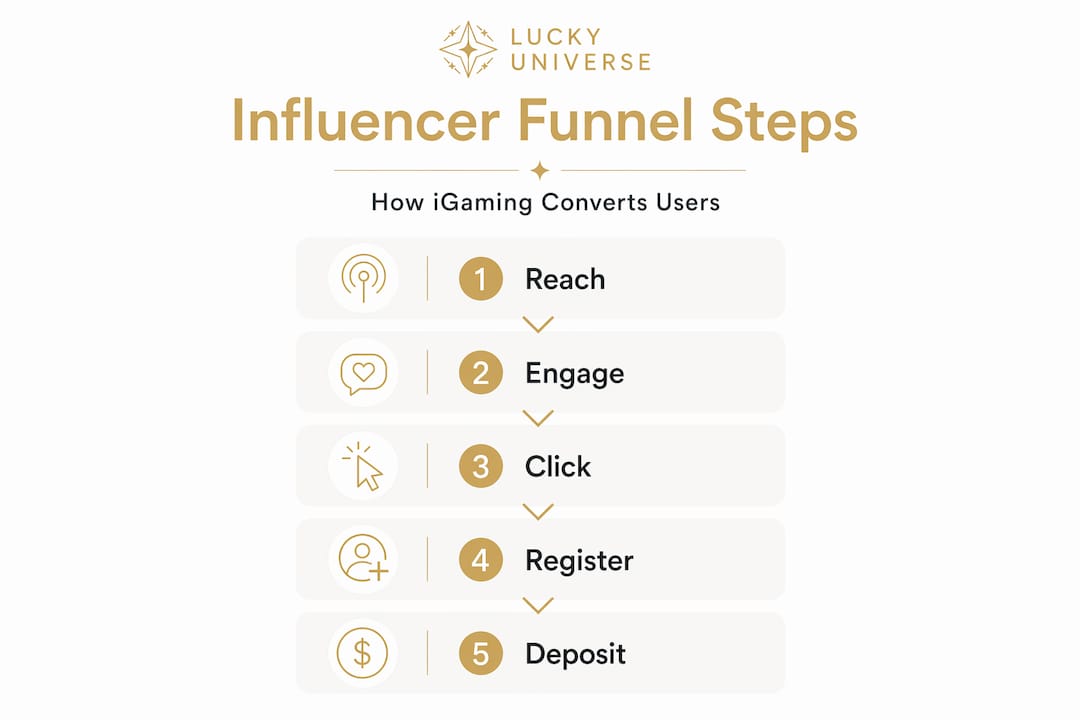
The conversion funnel you need to track looks like this:
| Funnel stage | What to measure | Why it matters |
|---|---|---|
| Click | Raw traffic from influencer link | Establishes reach and content appeal |
| Registration | New account creation | Indicates audience intent and offer relevance |
| First-time deposit (FTD) | Initial deposit completed | Primary acquisition KPI for most operators |
| Lifetime value (LTV) | Total net revenue per player over time | True ROI metric that determines campaign profitability |
The iGaming campaign measurement standard emphasises that first-time deposits are the starting point, not the finish line. Mapping individual player IDs acquired through an influencer campaign to their subsequent CRM activity is what lets you calculate whether a campaign that looked average on FTD metrics was actually your highest-LTV acquisition source of the quarter.
Pro Tip: Build your influencer tracking infrastructure before you brief any creator. Promo codes, UTMs, and landing pages must all be ready before the campaign goes live, because retroactive attribution is unreliable and you will lose data you cannot recover.
Campaign execution and optimisation
The tension at the centre of every iGaming influencer campaign is authenticity versus control. Compliant content must hit specific messaging requirements. Authentic content must feel genuinely unscripted. Managing that tension is where most operators fail, because they either over-brief influencers to the point where content sounds like a legal disclaimer, or they under-brief them and create compliance exposure.
The 2026 campaign execution framework that consistently produces strong results follows a structured progression:
- Brief with requirements, not scripts. Give influencers the mandatory compliance elements and the key messages, then let them communicate those in their own voice. Audiences detect inauthentic scripts immediately and disengage.
- Deliver trackable assets early. Unique links, promo codes, and dedicated landing pages must be live and tested before the influencer goes live. Any delay here causes attribution gaps that corrupt your data.
- Run content across the agreed platforms. Monitor performance in real time during the launch window so you can identify technical issues, such as a broken promo code, before they affect the full campaign.
- Evaluate performance by funnel stage. Do not wait until campaign end. Mid-campaign analysis lets you adjust messaging with the influencer if early conversion rates underperform.
- Convert top performers into long-term ambassadors. One-off campaigns produce one-off results. Ongoing ambassador relationships compound trust with the influencer’s audience over time and dramatically reduce cost-per-acquisition on repeat campaigns.
Avoid the common pitfall of optimising for view counts or click-through rates when your actual business goal is depositing players. How iGaming social media marketing works at a performance level is about the funnel, not the top of the funnel. Clicks that never convert are an expense, not a result.
Pro Tip: Influencers who promote educational content, such as how betting odds work or bankroll management strategies, rather than direct sign-up calls-to-action often produce better-quality depositors. The influencer funnel approach routes users through communities or messaging channels before presenting the operator offer, which tends to filter for higher-intent players.
Regulatory risks and emerging trends
The regulatory environment around iGaming influencer marketing is not static, and the direction of travel is clear. Enforcement attention on influencer promotions of unlicensed gambling operators is increasing. 2026 investigative reporting has highlighted how platforms use both machine learning and human review to enforce policies on gambling content, and regulators are paying close attention to the results.
The risks for operators who take a casual approach to compliance include:
- Licence reviews triggered by non-compliant influencer content linked to the operator
- Platform-level content removal, which destroys campaign value and damages the influencer relationship
- Fines or formal warnings from advertising standards bodies in markets like the UK, Sweden, or the Netherlands
- Reputational damage if an influencer continues posting non-compliant content after the formal campaign ends
One emerging dynamic that every iGaming marketer needs to understand is the pull of unlicensed operators on influencer talent. Black market operators offer higher commission rates and fewer restrictions, which attracts influencers who prioritise short-term earnings over regulatory safety. This creates a talent competition problem for licensed operators, who must position compliance not as a constraint but as a brand value that protects the influencer as much as the operator.
AI is beginning to play a meaningful role in compliance monitoring at scale. Automated tools can scan published content for prohibited phrases, missing disclaimers, or geo-restriction failures far faster than manual review. Integrating AI-driven content credibility tools into your monitoring workflow is increasingly practical for operators managing large influencer portfolios.
The rise of crypto gambling is also reshaping igaming influencer strategies. Crypto-focused platforms operate in regulatory grey zones in many jurisdictions, and some influencers are migrating toward promoting them precisely because oversight is less stringent. Licensed operators should treat this as a signal, not just a threat. Audiences following crypto gambling content are often high-intent players who will engage with a licensed alternative if it is presented with the same energy and transparency.
My perspective on compliance-led influencer marketing
I have watched iGaming operators approach influencer marketing in two fundamentally different ways. Some treat it as a content procurement exercise: find creator, agree fee, publish content, count clicks. Others treat it as a managed performance programme with the same operational rigour they apply to paid search or affiliate marketing. The second group consistently outperforms the first, and the gap is widening as regulatory pressure increases.
What I have learnt working in this space is that compliance is not the enemy of authenticity. The operators who build genuine long-term relationships with influencers, provide real support for compliance requirements, and give creators actual creative latitude produce content that audiences trust. That trust converts at a higher rate than any scripted promotional post ever will.
The ROI story in iGaming influencer marketing never lives in first deposits alone. I have seen campaigns that looked poor on FTD metrics turn into the operator’s highest-LTV cohort three months later, simply because the influencer attracted a genuinely engaged audience who played regularly rather than bonus hunters who churned immediately. You will never know that if you close your attribution model at deposit.
Stay close to regulatory developments. The operators who are agile enough to adapt their influencer programmes quickly when a market changes guidelines are the ones who maintain clean licence records and competitive positioning simultaneously. Compliance is not a one-time briefing. It is an ongoing management discipline.
— Lucky
Take your influencer campaigns further with Myluckyuniverse

Myluckyuniverse has spent over 20 years at the intersection of iGaming media and performance marketing. If you are looking to build influencer campaigns that stand up to regulatory scrutiny while delivering measurable player acquisition, our editorial and data infrastructure is built for exactly that purpose. From compliance-aware content frameworks to structured attribution models, we publish the kind of analysis that helps marketing teams make sharper decisions. Explore our iGaming marketing insights or visit Myluckyuniverse directly to see how our platform supports operators who take performance seriously.
FAQ
What is the main difference between iGaming influencer marketing and standard influencer marketing?
iGaming influencer marketing requires operator-managed compliance workflows, age and location gating, and multi-layer attribution tracking. Standard influencer campaigns rarely carry the same legal responsibility or conversion measurement demands.
How do you track ROI from an iGaming influencer campaign?
The standard method combines UTM tagging for traffic attribution with promo codes and affiliate dashboard reconciliation for conversion tracking. True ROI is calculated using player lifetime value, not first-time deposits alone.
What are an operator’s legal responsibilities for influencer content?
Under regulations in most jurisdictions and standards such as the EGBA Pledge, operators are legally responsible for all influencer content published on their behalf. This includes mandatory pre-approval, responsible gambling messaging, and ongoing monitoring of published material.
Which platforms work best for iGaming influencer campaigns?
Twitch suits live play and community engagement, YouTube works for in-depth reviews and sportsbook analysis, and short-form platforms like TikTok reach broader audiences but face stricter content enforcement from both platforms and regulators.
Why do long-term influencer partnerships outperform one-off campaigns?
Repeated exposure through a trusted creator builds audience familiarity and intent over time. Ambassador programmes also reduce cost-per-acquisition on subsequent campaigns because the tracking and compliance infrastructure is already established and the audience is already warmed up.